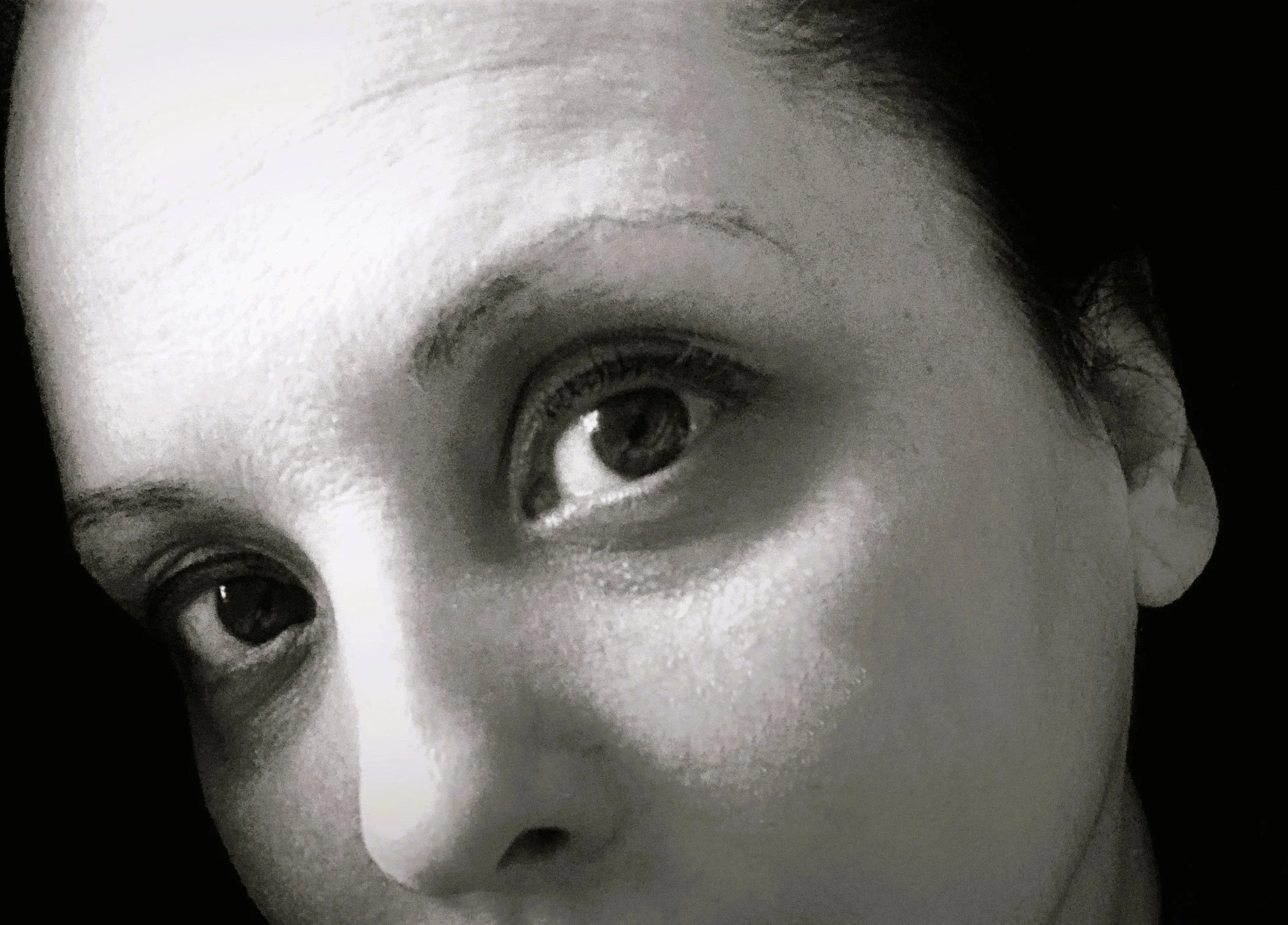
What I’m Learning: “Expanding” Our Language/ing Ecologies
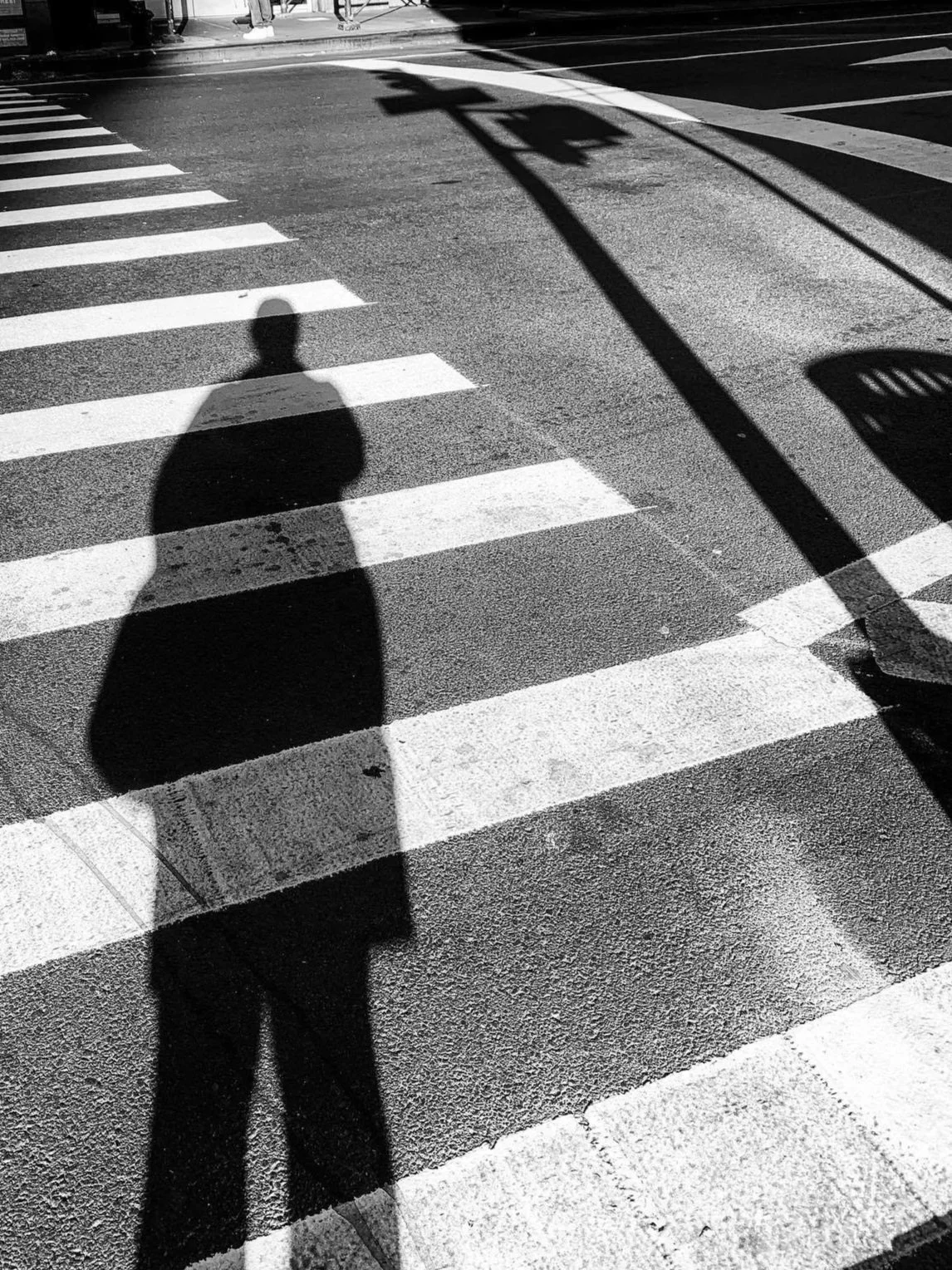
"Every act of knowing brings forth a world…All doing is knowing and all knowing is doing”" — Humberto Maturana & Francisco Varela (The Tree of Knowledge, p. 26)
The summer 2026 semester is drawing to a close and I’m reflecting on the grand responsibility that we, people who draw learning journeys for others, have in keeping our own learning in a state of constant questioning and growth. For a number of years I have been on a quest to try to imagine more expansive ways of describing communication in our lives and in the spaces in which we exist - our cities, our neighborhoods, and our relationships with those places and the people in them. I have often explored this via student self-interrogation, poetry, creation of digital collaging, or in experiential field trips to art museums, art studios, or schools.
Reading ‘Place’ as Meaning-Making
This semester I went very broad and gave my co-learners a community observation: We were invited to observe how communication (not just spoken!) emerges across an environment through relationships between humans, the more-than-human, human-made materials, and space. I suggested attending to gesture, silence, rhythm, spatial arrangements, routines, and objects in specific exchanges, keeping in mind that this was not a study of people. My rationale is that most of the time we are immersed in and co-producing the very critical ideas of language/communication we discuss in abstract ways in the classroom. To anchor their observations, I invited them to consider:
Where is languaging happening?
What does the environment make possible?
What (kind of languaging) might usually go unnoticed?
What sensory details (smells, sounds, textures…) are standing out to you?
What emotions, reactions, or feelings are emerging as you move through the space?
What systems (e.g., institutional rules, prescriptions or rules of what is correct/incorrect), do you notice may have an impact on what languaging you are recording?
“Knowledge depends on being a world that is inseparable from our bodies, our language, and our social history — in short, from our embodiment”
Critical Belief Anchors: Enactive Thought & Place-Based Languaging
Grounding our observations in Maturana and Varela’s work on languaging, enaction, embodiment, the non-duality in the mind and the body - as well as readings by Jon Henner and Octavian Robinson (2023) on crip languaging, allowed us to explore “place-based languaging.” - Lots of other people to cite but also this is a blog (check a list of some of what I am reading below)
Varela’s text with Thompson and Rosch is a must read - I’m back into it after reading portions of it as I was seeking some understanding of the roots of translanguaging theory/ stance a number of years ago. I think my mind was probably not mature enough nor deep enough in the concepts it now dwells in to reap the expansiveness of its meanings. These scholars - who were certainly ahead of ‘their’ time- suggest that we make sense of the world (sense-making) through our interpretation, which always is done in ‘communal’ entanglements (i.e., relating with events, people, places, the more than human world - the routine and the political, the abstract and perhaps even the magical)
If knowledge and knowing is iterative, dynamic and embodied, as such, language/ communication in its active form is also an evolution of patterns of embodied experiences, in a dance with our ‘ perceptual sensibilities’ and testing the community-demarcated codes for what is 'meaning-full’. I’m not going to do it justice in a blog post. But the text itself definitely has influenced my thinking and continues to challenge me to change what I create as experiences and ‘performances’ in our higher education classroom spaces, even when my own knowing is limited to my own understandings of the theory itself. I do wonder what would be of higher education if didactic courses shifted to incorporate, intentionally, embodiment and multimodality as praxis and not just as content and strategies we expect our students to carry forth into their teaching and intervention spaces. I’m lucky to be exploring some of these curiosities with brilliant colleagues currently.
So, it is this concept we attempted to explore this semester: Languaging is always situated—it unfolds in real time through our continuous, lived interactions with our environment and the physical forms around us. I’m theorizing that the more we take language/communication outside of its societal comforts of ‘the body’ the more we may be able to move away from ‘pathologizing’ ‘it’ (the bodymind).
When we view space through this enactive lens, everyday environments reveal their active participation in meaning-making. A park bench isn't static wood or metal; it actively shapes human proximity, body orientation, posture, and the pacing of a conversation. A busy street corner becomes a snapshot of shared routines, subtle spatial cues, and unspoken communal agreements. Even simple physical objects and materials (e.g., trash left behind on a fountain) mediate human connection, silently inviting or constraining how we show up and participate with one another - or curiosity for telling the story of the thing we perceive. By foregrounding place-based languaging, co-learners begin to feel how space continuously speaks, listens, and shapes our shared presence.
Languaging Ecologies & Getting Back in the Body
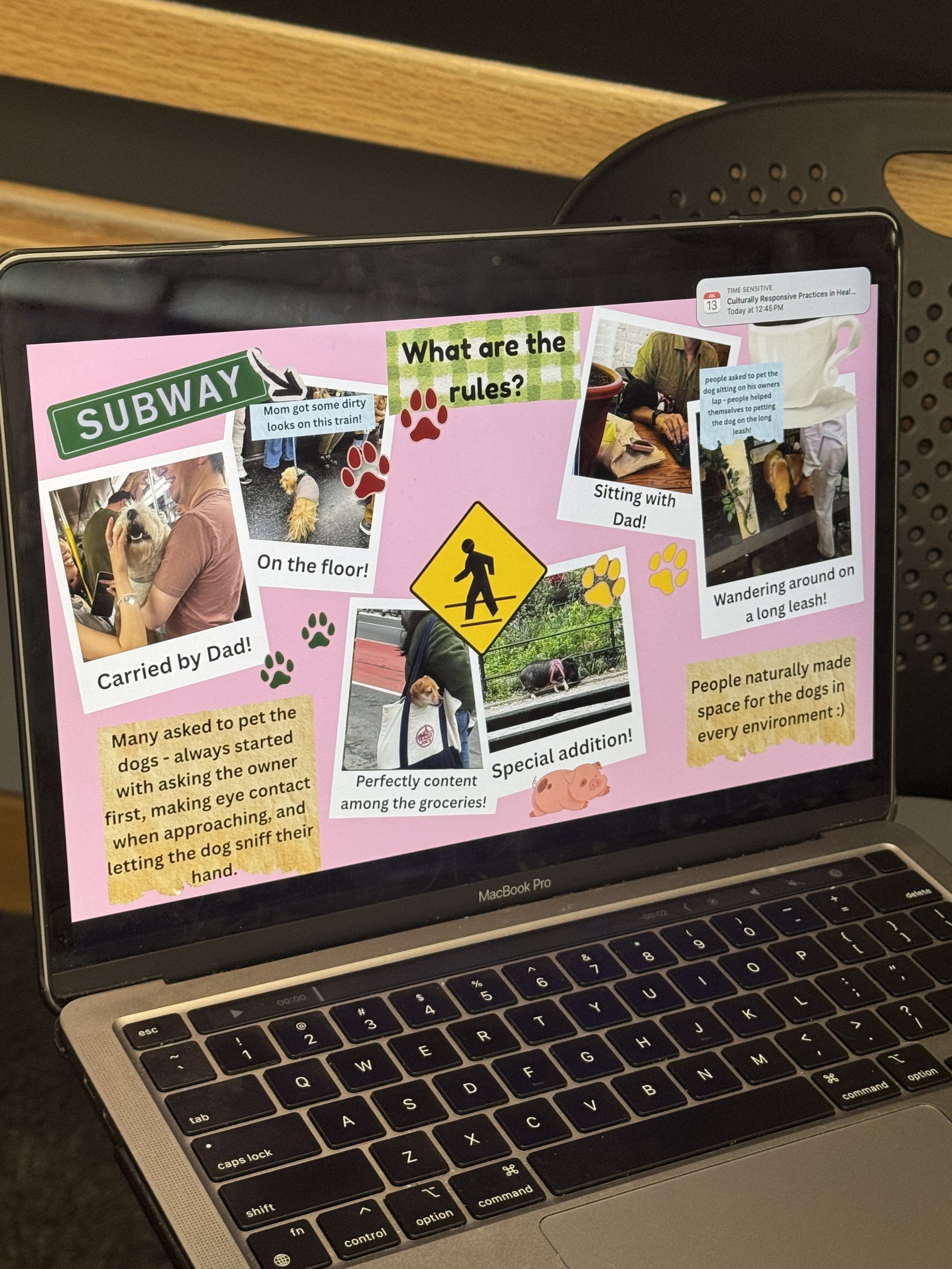
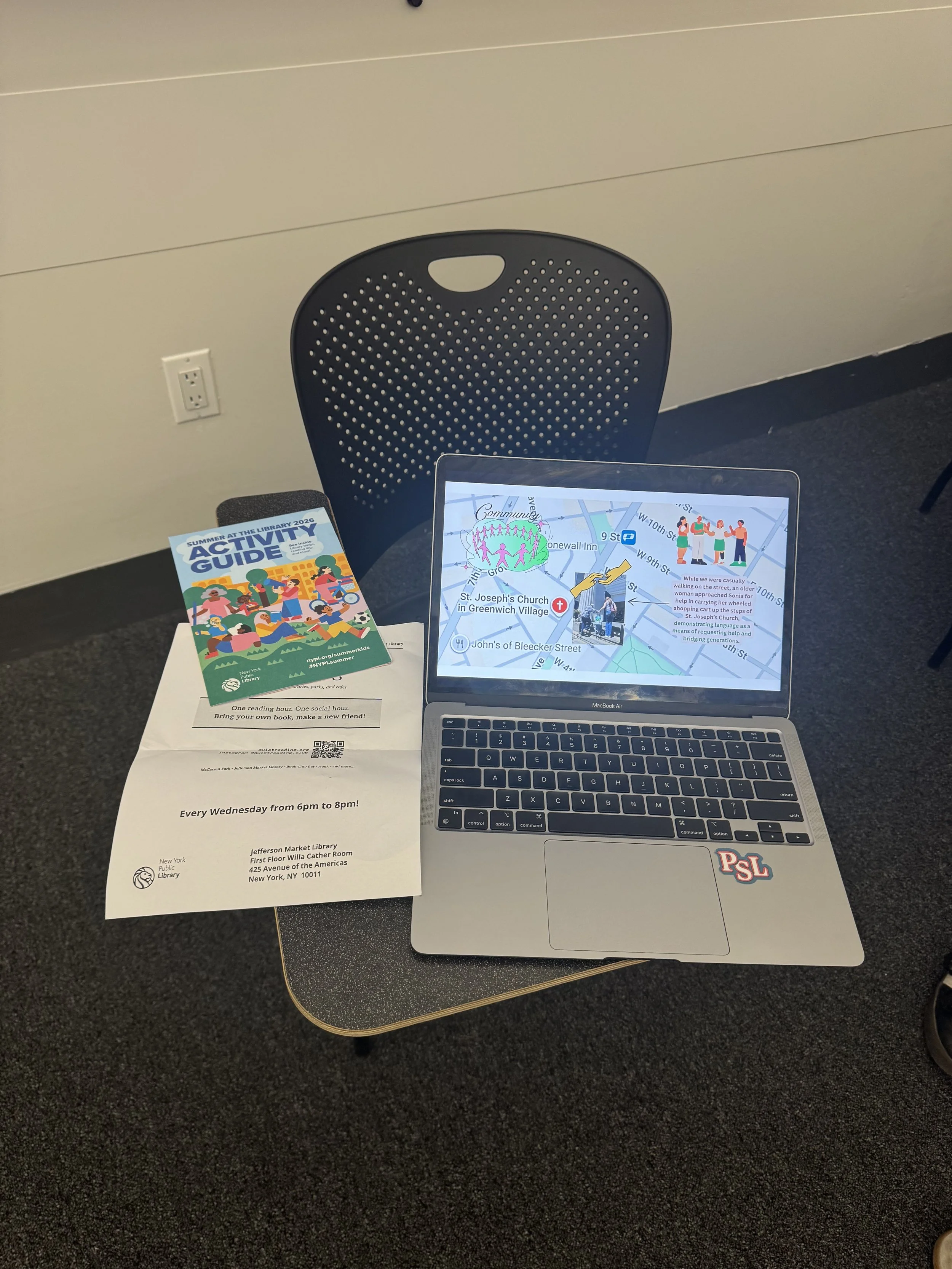
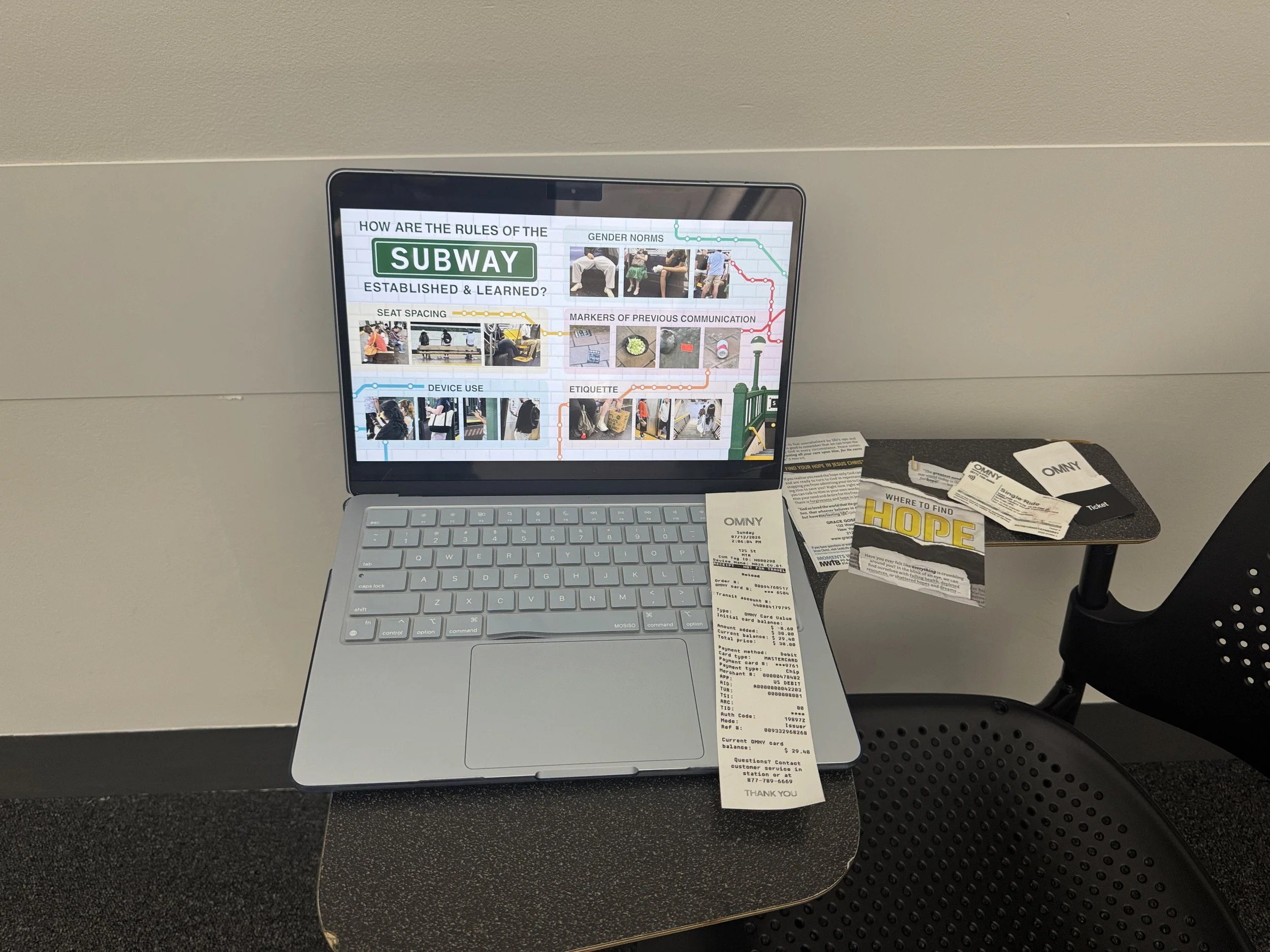
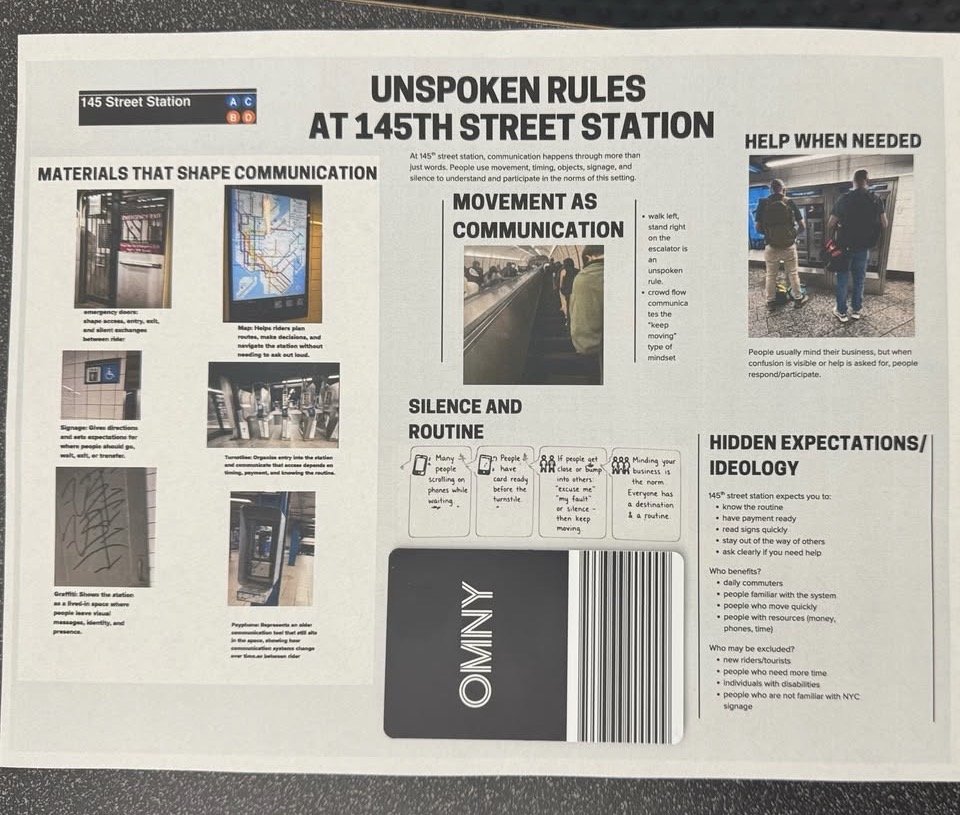
Their reflections revealed just how omnipresent communication is in every corner of our shared world. They observed how silent social expectations—like standing on one side of an escalator or sensing an atmospheric shift toward quiet inside a library—act as powerful, ongoing forms of nonverbal interaction. Others noticed how environmental design, from subway signage and directional maps to the presence or absence of braille and multilingual translation, continuously communicates who a space welcomes and accommodates. So, they made visible the ‘societal’ ideologies, too - which was a connection to our early foundational explorations (Brea-Spahn & Bauler, 2023) on ‘beliefs’ of languaging done earlier in the term.
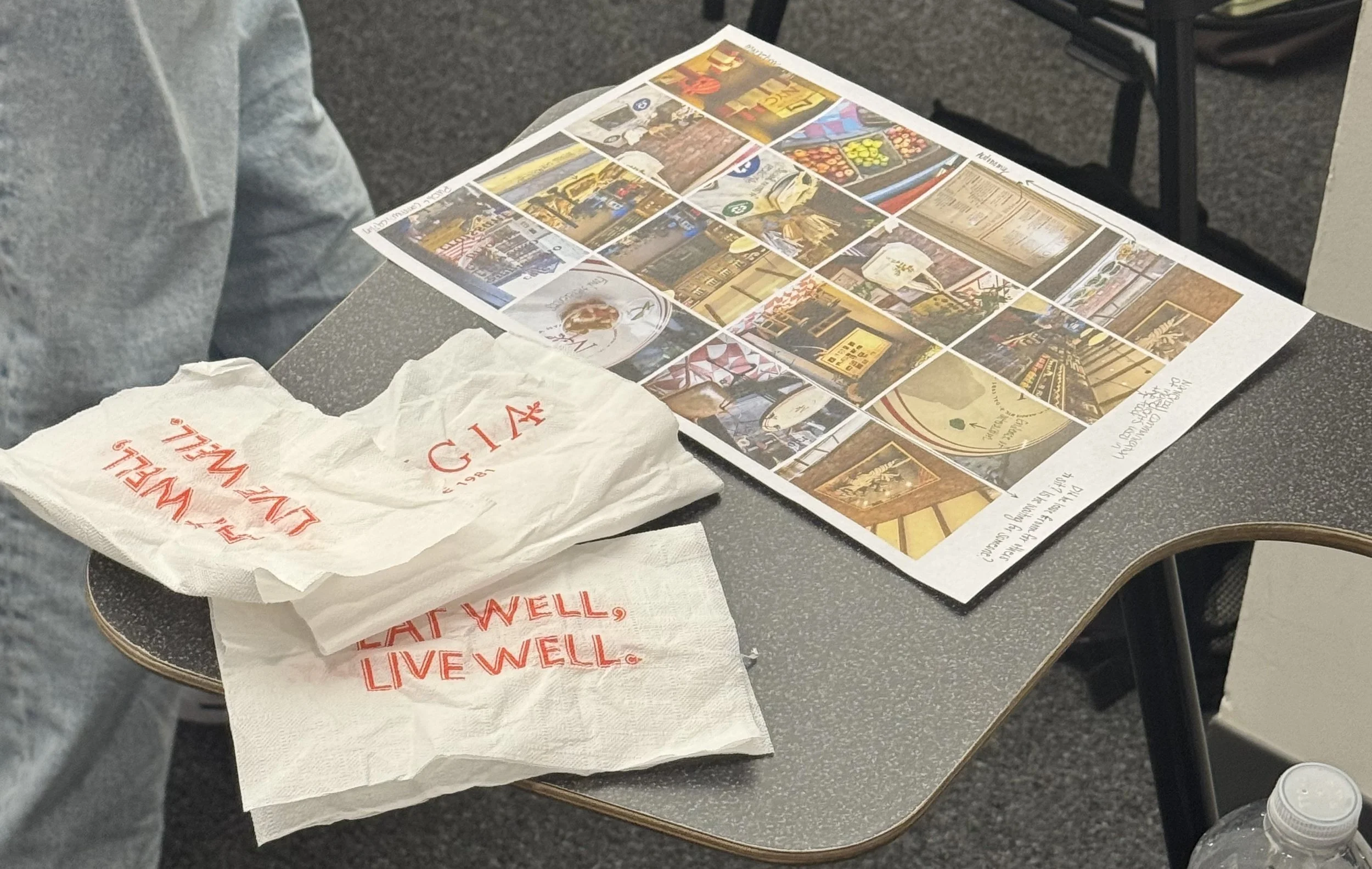
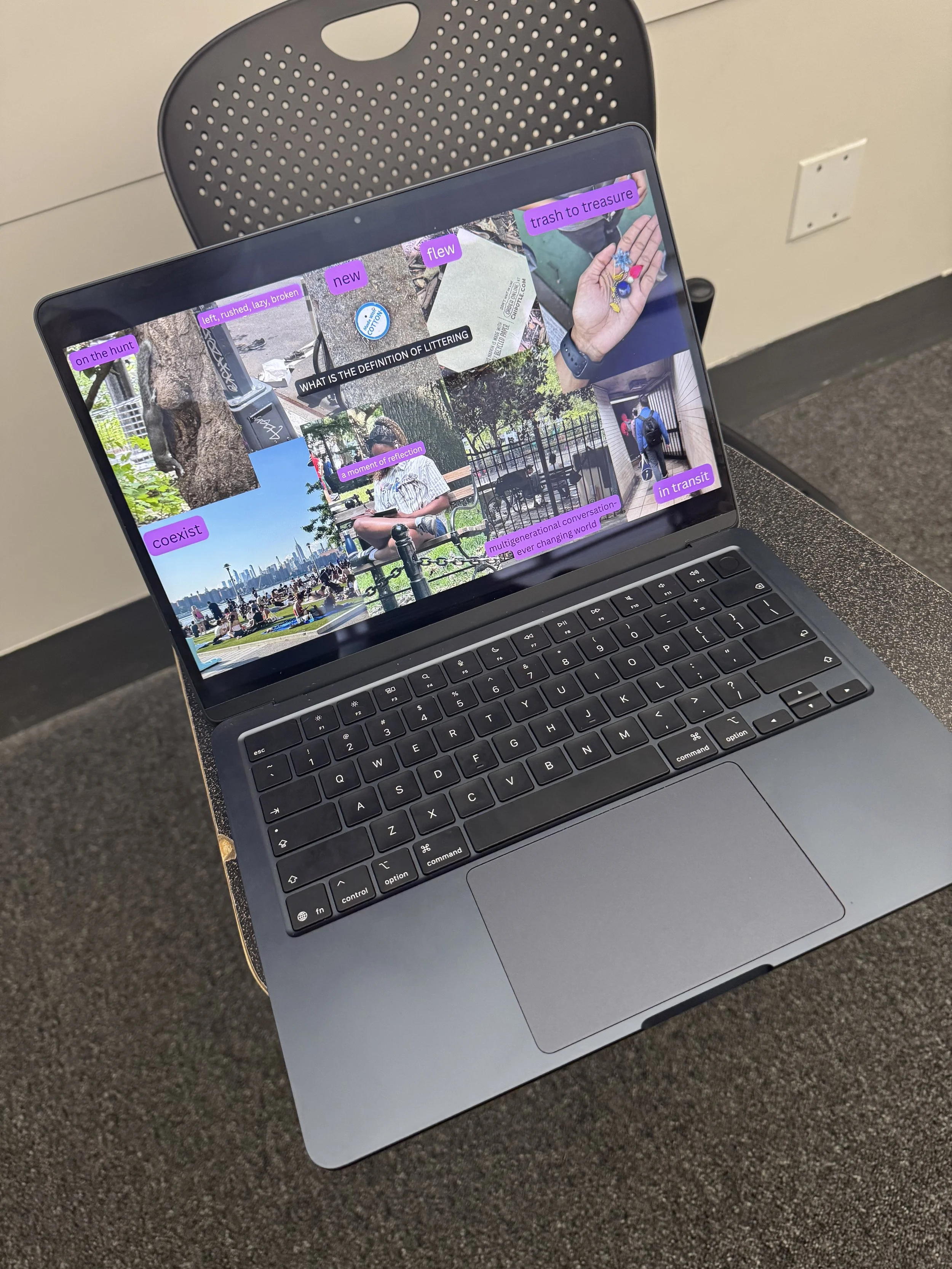
When making their learning visible, co-learners embraced modalities that - as per revealed in their reflections -matched their own internal processing. Some leaned into fast-paced, movement-based TikTok-style media with floating visual fragments because that format resonated with how they learn, while others constructed physical collages, soundscapes, or digital maps. They also shared their collected material evidence like bus tickets, wrappers, texture rubbings, and flyers
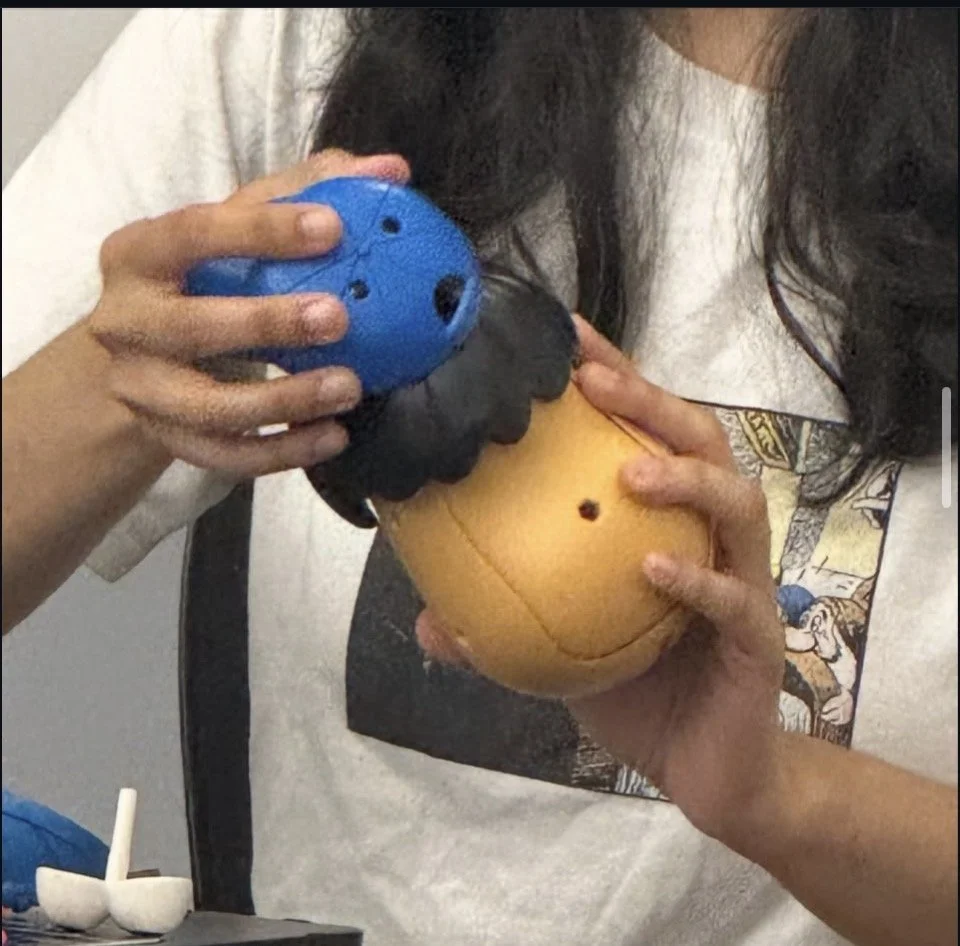
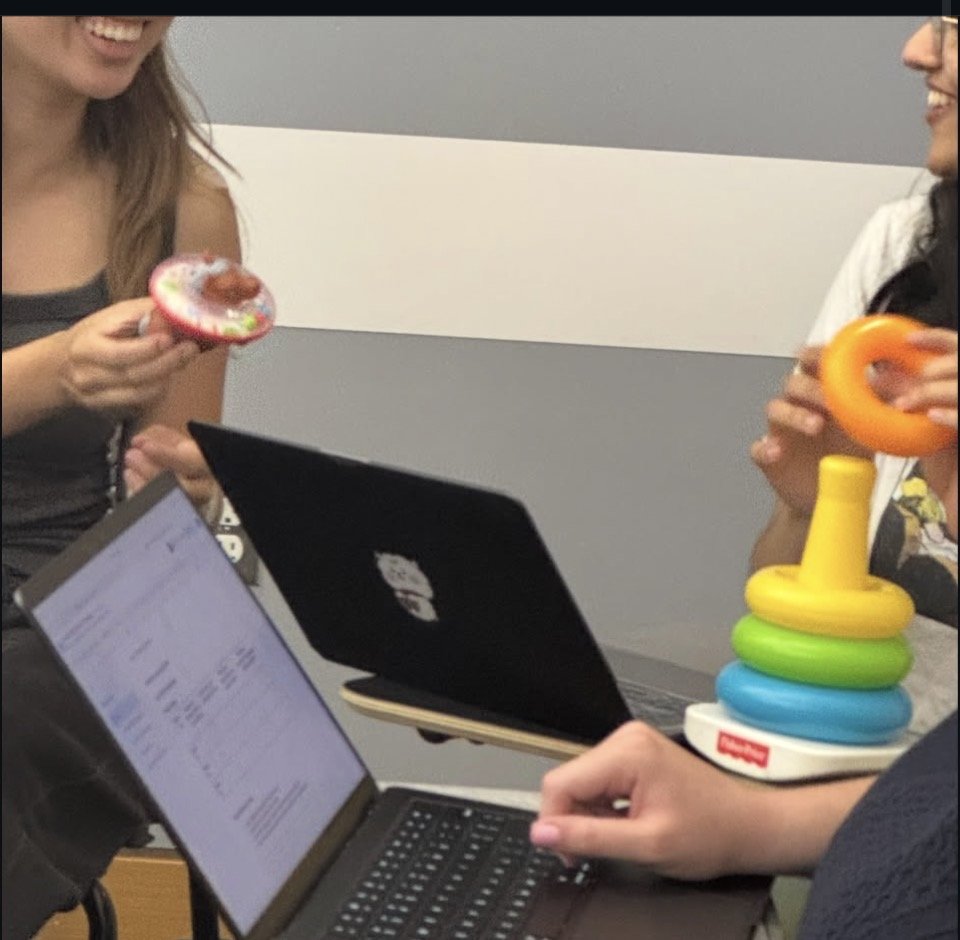
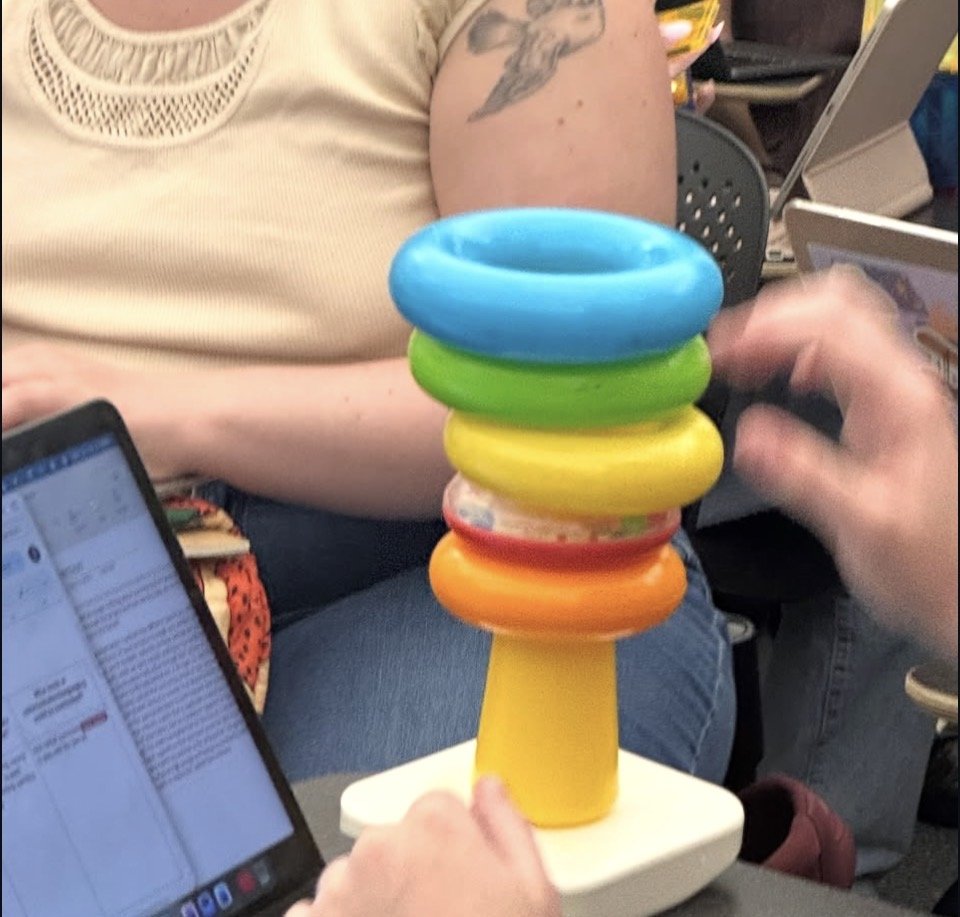
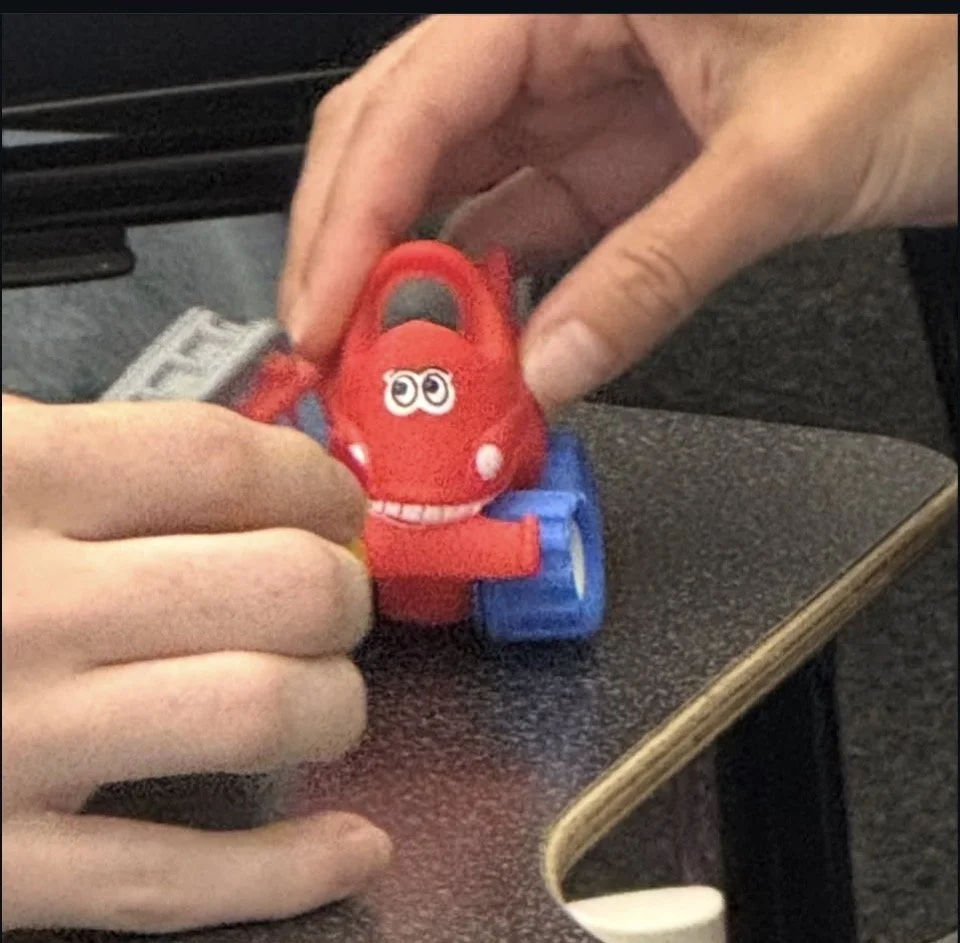
And on the topic of embodiment - and the praxis of it - in the subsequent weeks, we "got back in our bodies" to play. They found the languaging centered and not explored in the traditional and inventive use of toys. Play allowed us to feel the theory, positioning physical touch, spatial arrangement, and raw materials as active forms of communicative expression.
What’s Next: Liberatory Pedagogies & Reggio Emilia
We are now preparing to delve into the DIRFloortime Framework and Reggio Emilia pedagogy—specifically its concept of the environment as the third teacher.
Liberatory education requires us to explore while experiencing expansive ways of knowing and being alongside traditional modes of expression. By reading our environments, honoring material relationships, and grounding our learning in embodied play, we create accessible pathways for everyone to participate in meaning-making.
Ultimately, designing these learning journeys compels me to return to my own self-interrogation. Watching my co-learners uncover meaning in silent rhythms, everyday materials, and spatial arrangements challenges the boundaries of how I conceptualize language and pedagogy. If I ask my students to stay curious about how communication unfolds in the world, I must hold myself to that same standard of continuous reflection. Pedagogy is not a static set of rules to deliver; it is a living practice of co-creating worldviews together, staying open to surprise, and remaining in a constant state of questioning and growth.
Some of What I Read:
Badwan, K., Dower, R. C., Farah, W., Flewitt, R., Hackett, A., Holmes, R., MacRae, C., Nair, V. K. K., & Shannon, D. B. (Eds.). (2025). Language, Place, and the Body in Childhood Literacies.
Brea-Spahn,M. R., & Bauler, C. V. (2023). Where do you anchor your beliefs? An invitation to interrogate dominant ideologies of language and languaging in Speech-Language Pathology. Language, Speech, and Hearing Services in Schools, 64(3), 1-13. https://doi.org/10.1044/2023_LSHSS-22-00135
Ceppi, G., & Zini, M. (Eds.). (1998). Children, spaces, relations: Metaproject for an environment for young children. Reggio Children.
Hackett, A. (2021). More-Than-Human Literacies in Early Childhood. Bloomsbury Academic.
Hackett, A., & Somerville, M. (2017). Posthuman literacies: Young children moving in time, place and more-than-human worlds. Journal of Early Childhood Literacy, 17(3), 374-391.
Henner, J., & Robinson, O. (2023). Unsettling languages, unruly bodyminds: A crip linguistics manifesto. Journal of Critical Study of Communication and Disability, 1(1), 7–37. https://doi.org/10.48516/jcscd_2023vol1iss1.4
Maturana, H. R., & Varela, F. J. (1992). The tree of knowledge: The biological roots of human understanding (Rev. ed.). Shambhala Publications.
Odell, J. (2019). How to do nothing: Resisting the attention economy. Melville House.
Perec, G. (1997). Approaches to What? In J. Sturrock (Ed. & Trans.), Species of spaces and other pieces (pp. 209–211). Penguin Books. (https://adk.elsevierpure.com/ws/files/58583644/Proceeding_The_Infraordinary_as_Spatial_Discourse_ELN2.pdf)
Shannon, D. B., & Hackett, A. (2024). The entanglement of language and place in early childhood: A review of the literature. Critical Inquiry in Language Studies, 21(2), 147-169.
Yoon, H., & Templeton, T. N. (2019). The challenges of hearing children out in an adult-curated world. Harvard Educational Review, 89(1), 125-147.