What I’m Learning: A Window into Reggio Emilia, Slow Pedagogy, and Remaining Unfinished
For almost two years now, I have been in deep self-study around the Reggio Emilia Approach®, not in the formal, credentialed sense that academia often rewards, but in the slower sense: reading, revisiting ideas, sitting with tensions, noticing what keeps returning, dialoguing with colleagues and friends. It’s become a bit of an obsession, to be honest. This spring, I finally had the unique opportunity to travel to Reggio Emilia, Italy, to spend a week at the Loris Malaguzzi International Centre, where this philosophy continues to live, evolve, and provoke.
The history of the Reggio Emilia pedagogical philosophy is a story with its own “grammar of fantasy” (Rodari, 1973). It took place in the mid 19th century, after the fall of the fascist government when, in a small municipality of Northern Italy named Reggio Emilia—the birthplace of the tricolored Italian flag, a tank, six horses, and two trucks left behind after WWII served as the initial funding sources for a school. It was a school for young children that women within the Unione Donne in Italia (Italian Women’s Union), with the help of a young teacher named Loris Malaguzzi, envisioned and built brick by brick. A wide system of early childhood centers now exists within Reggio Emilia that espouses the values of this philosophy, and worldwide—including in Canada, the United States, Central and South America, Africa, China, and Australia, among some —schools continue to take inspiration from these ideals and practices in the design and implementation of learning spaces.
At the center of the Reggio Emilia Approach is an expansive vision of the child—not only positioned as “competent,” but as protagonists and full citizens of a world always in a state of dynamic evolution and complexity. Its manifesto is the “100 languages” —signifying multiplicity in meaning-making through embodied expressions (speech, graphic language, gesture, movement…) and through children’s entanglements and collaborations with other humans, materials, and the more-than-human world. As such, it’s a critical philosophy of the “project of education.” It redefines the role of teachers as co-learners, researchers, and documenters whose purpose is to facilitate and make learning visible. It provokes adults to listen—in all the multifaceted ways known and unknown—and to remain present. It invites the circularity of knowledge and ideas, differing perspectives, and liminalities outside of binaries. It requires commitment to participation, design thinking, and courage in dialogue. Space is insufficient to do this way of living justice. So I encourage us all to read about it.
But returning to this recent journey…and to learning.
As professors, I think we are often quietly socialized out of our own learning. We become experts, facilitators, evaluators—humans expected to guide the intellectual journeys of others while placing our own becoming somewhere in the background. I’ve resisted these ideas, even in my pedagogical design. No course I have ever taught has been designed or carried out exactly the same from term to term. It becomes a challenge to my own body in this capitalistic machine called the university, and in my institution, and my role as a 12 month faculty in particular, when there are no clean breaks between semesters. But my commitment is to learning that is becom-ing. My perspective is that learning—in life and in the classroom—is relational, recursive, and lifelong.
This disposition is definitely one reason I found myself so drawn to Reggio Emilia. As Malaguzzi shared in his writings:
“Learning and teaching should not stand on opposite banks and just watch the river flow by; instead, they should embark together on a journey down the water.” (Malaguzzi, 1998, p. 83).
That line feels particularly important in this moment within higher education and speech-language pathology, where “professional” expertise in the form of standardized competencies can so easily harden into certainty and objectivity; where conversations about educating the next generation of speech-language practitioners dissolve into reductionist approaches to skills-based learning. As said before, in Reggio Emilia, teachers are researchers, learners among learners. Knowledge is not “perfect” and it is not transmitted neatly from one body to another and assessed via tests.
To know/ to learn is… to experiment with and to co-construct meaningfulness “in relationship with others and [knowledge] is constructed by each individual through the process of making sense of experience” through dialogue, documentation, exploration of materials, relationships, and time (Rinaldi, 2006; p. 65).
How are we co-creating spaces in the academy for this type of knowing?
If learning happens in relationship, it follows that communication does not emerge detached from bodies, environments, cultures, technologies, memories, and relationships. That is, meaning is always co-created. As a speech-language therapist, I could not stop thinking about how differently communication is imagined there.
Much of our field still privileges communication that is fast, measurable, standardized, and speech-centered. Even when we discuss multimodality, speech often remains the desired endpoint. My own work in “liberated languaging” has emerged from questioning those assumptions and disrupting ideologies of “good” communication that position some ways of meaning-making as more valuable than others with my students, through art-making (Brea-Spahn & Soto-Boykin, 2025). Reggio Emilia philosophy is aligned with this (very personal journey of) questioning, particularly in its refusal to reduce communication to languaging detached from relationships, materials, culture, or socio-political and educational context. That is, this is a philosophy that refuses “communicative narrowing”. Imagine the possibilities and potentialities of this stance, philosophical perspective into Speech-Language Pathology and pre-service preparation programs in higher education. More on this very soon!
“The child has a hundred languages (and a hundred hundred hundred more).” (Malaguzzi, 1993/2012)
Malaguzzi’s Hundred Languages poem is quoted often, but being there made me realize it is less of a symbolic stance; it is a political position. The hundred languages are not simply expressive modalities. They represent an expansive understanding of human meaning-making itself. This merits its own blog post later.
Time is also defined differently in this pedagogical stance. I grew up in the Dominican Republic where there was time to go home for a sit-down almuerzo with the familia and then a siesta. So I know about time being a construction…but in terms of teaching and learning, there is often only one way - the institutional version - of defining “the teaching and learning clock".
In preparation for my travels, I read Slow Knowledge and the Unhurried Child: Time for Slow Pedagogies in Early Childhood Education by Alison Clark, which also alludes to her work with Peter Moss. Both have written extensively about resisting the acceleration and “hurriedness” that shape contemporary education systems. To become “slow” in knowing is to make space for attention, uncertainty, revisiting concepts, relationship-building, and learning depth.
During the visit, we had the opportunity to attend lectures, observe schools, and even participate as learners in ateliers. I neglected to say that the arts—visual arts, music, movement—are all scaffolds and means and mediums for exploration and inquiry. Each school has studio spaces, some classrooms even have their own mini art studios, and atelieristas, or teaching artists. This is part of the inquiry into the hundred languages of the child.
I felt this “slowness” in the ateliers, in the long-term projects, and in the ways children revisited ideas through clay, light, shadow, photography, (unfamiliar) loose object parts, musical instruments, and natural materials. The pedagogical documentation displayed across schools differed sharply from the ways we are - as professors and as clinicians - often taught to quantitatively and qualitatively '“measure” performance outcomes. Instead, it invited me to view learning as an incomplete process, akin to leftover pebbles of evidence that thinking is continuously in motion.
Reggio Emilia reminded me that remaining unfinished may actually be central to learning.
Remaining unfinished means a willingness to:
…remain open.…continue noticing.…become elastic in our subjective-self-ideological-transforming.
And perhaps that is my Reggio-inspired approach —not a set of strategies, but a re-commitment to the incompleteness of my own learning, and that of my co-learners’: A reminder to resist urgency long enough to listen “care-fully,” remain porous to surprise, and to continue the becoming in relationship with others, even when we are at the podium or a chair, at the front of a classroom.
Keep learning:
Brea-Spahn, M. R., & Soto-Boykin, X. (2025). Imagining liberated languaging in early childhood with preservice speech-language practitioners. In M. Beneke & H. R. Love (Eds.), Beyond compliance in early childhood education: Centering disability, freedom, and belonging (pp. 147–159). Teachers College Press.
Clark, A. (2023). Slow knowledge and the unhurried child: Time for slow pedagogies in early childhood education. Routledge.
Malaguzzi, L. (1993/2012). The hundred languages of children. In C. Edwards, L. Gandini, & G. Forman (Eds.), The hundred languages of children (3rd ed.). Praeger.
Malaguzzi, L. (1998). “History, ideas, and basic philosophy.” In C. Edwards, L. Gandini, & G. Forman (Eds.), The hundred languages of children (2nd ed., p. 83). Ablex.
Rinaldi, C. (2006). In dialogue with Reggio Emilia: Listening, researching and learning. Routledge.
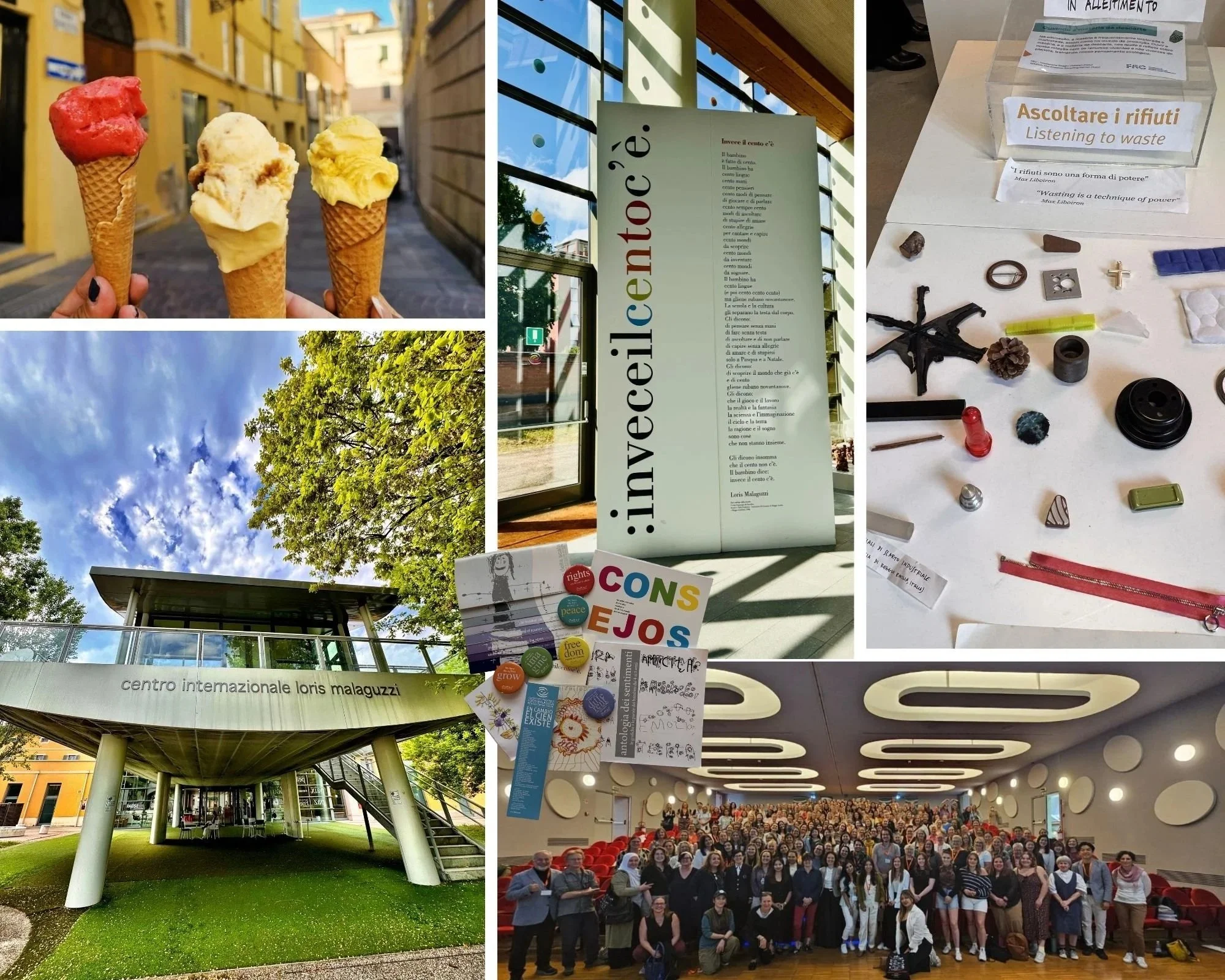
Collage of photos including the Centre, literature, the entire study group representing 48 countries, materials and provocations (questions to elicit creativity in children), and the 100 languages poem.